Secondary 1 Posting in Singapore Explained

After PSLE results, you submit up to six secondary schools in order of preference within seven days. MOE posts students by PSLE Score within their Posting Group, going down each choice list from the first choice. When students with the same score compete for the last place, tie-breakers apply in order: citizenship, choice order, then balloting.
Secondary 1 (S1) posting is how MOE places PSLE students into secondary schools. It runs on three things: your child’s PSLE Score, the Posting Group they are eligible for, and the order in which you list up to six schools. There is no interview and no separate application — just your ranked choices and the national posting run.
The three ingredients
Students are posted based on:
- PSLE results, applied within the student’s eligible Posting Group.
- Choice order of schools, from the first choice downwards.
- Vacancies in the chosen schools.
A student with a better PSLE Score is considered ahead of one with a poorer score. MOE works through students by merit, placing each into the highest school on their list that still has a place.
Submitting choices
After the PSLE results are released, you have seven calendar days to submit up to six secondary schools in order of preference through the S1 Portal. If your child is eligible for two Posting Groups (for example Posting Groups 2 and 3), you choose one before submitting, and that choice applies to all six schools.
If you submit no choices at all, your child is posted to a school that still has vacancies after everyone else, based on the registered address — which may not be close to home. So it always pays to submit choices.
How the tie-breakers work
Most of the time merit settles posting: the better score gets the place. Tie-breakers only matter when two or more students with the same PSLE Score compete for the last available place in a school. They are applied in this order:
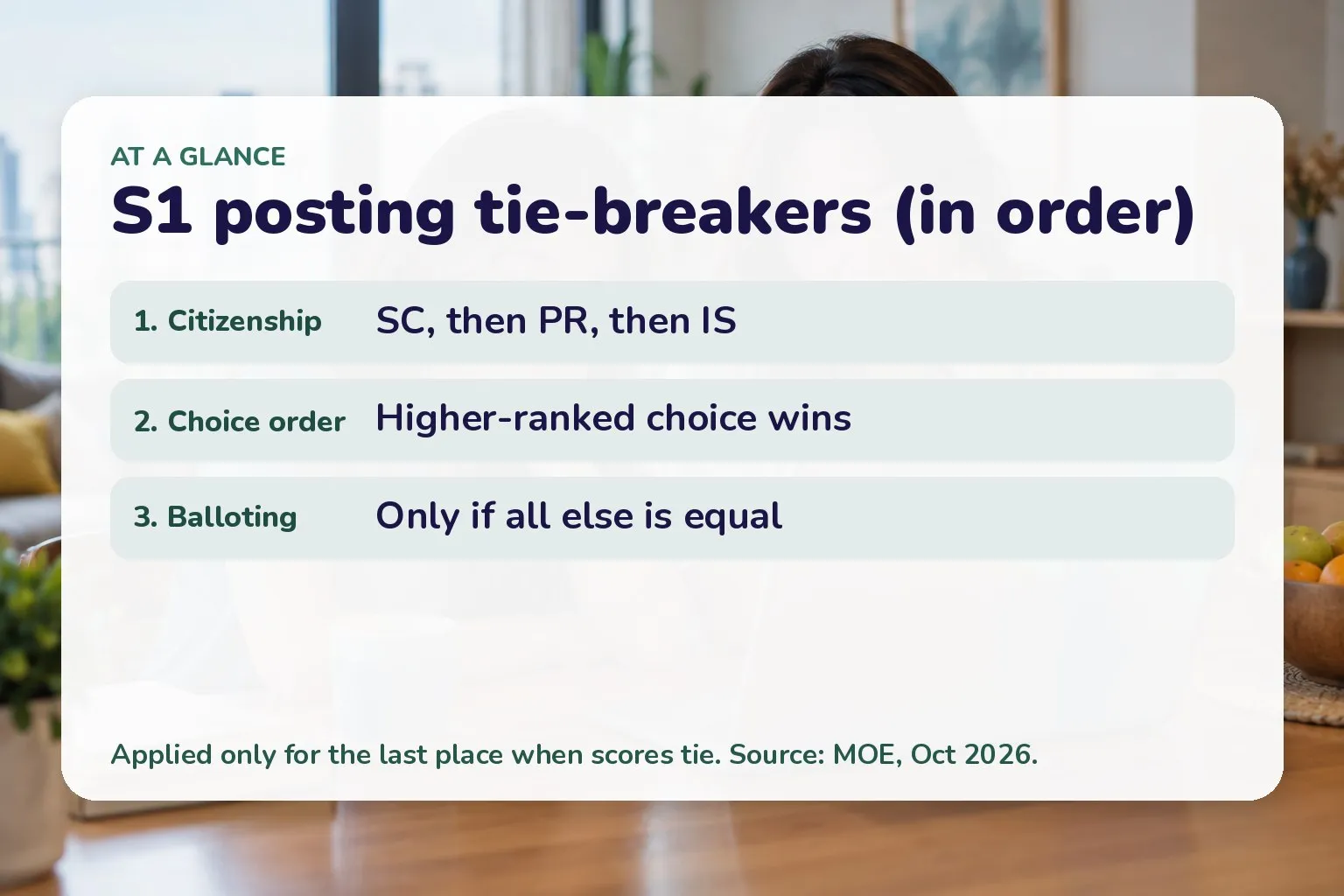
Merit first; tie-breakers only decide the last place. Source: MOE.
| Order | Tie-breaker |
|---|---|
| 1 | Citizenship — Singapore Citizen, then Permanent Resident, then International Student |
| 2 | Choice order of schools — a higher-ranked choice wins |
| 3 | Computerised balloting |
Choice order as a tie-breaker is why ranking matters: if two citizens with the same score want the last place, the one who ranked that school higher is posted. Balloting is used only when score, citizenship and choice order are all equal.
How to rank your six choices
MOE’s guidance is practical and worth following:
- Include two or three schools where your child’s score is better than the school’s previous cut-off point.
- Rank your genuinely preferred schools higher.
- Fill in all six choices, mixing schools with different past COPs.
- Look beyond the number — consider programmes, CCAs, culture and distance.
For the 2022 posting exercise, MOE reported that more than 80% of students were posted to one of their first three choices, and more than 90% to one of their six. Using all six choices sensibly is the best way to land a good fit.
Before results day
Read how your PSLE Score and AL bands translate into a Posting Group, understand that cut-off points move and are only a guide, and if your child received a DSA-Sec offer, remember they do not take part in S1 posting.
General information based on MOE sources, not official guidance. Confirm current rules and dates on moe.gov.sg.
Sources
- Secondary 1 (S1): Learn how posting works — Ministry of Education Singapore (as of October 2026)
- Secondary 1 (S1): Submit school choices — Ministry of Education Singapore (as of October 2026)
- FAQs — PSLE Scoring System (posting) — Ministry of Education Singapore (as of October 2026)