Full Subject-Based Banding Explained

Full Subject-Based Banding has replaced the Express, Normal (Academic) and Normal (Technical) streams. Students are posted to secondary school through Posting Groups 1, 2 and 3, based on their PSLE Score, and take each subject at level G1, G2 or G3 by strength. A student can take different subjects at different levels and move a subject up as they progress.
Full Subject-Based Banding (Full SBB) is the system that replaced the old Express, Normal (Academic) and Normal (Technical) streams. Instead of being placed in one stream for everything, a student is posted into a Posting Group and then takes each subject at the level that fits — G1, G2 or G3. The aim is to let a child stretch in their stronger subjects without being capped by a single stream.
The three subject levels
Under Full SBB, English, Mother Tongue, Mathematics, Science and the Humanities are offered at three levels:
| Level | Broadly equivalent to |
|---|---|
| G3 | the former Express standard |
| G2 | the former Normal (Academic) standard |
| G1 | the former Normal (Technical) standard |
“G” stands for General. A student might take Mathematics at G3 but a language at G2 — the combination follows the child’s strengths rather than one label.
How Posting Groups are assigned
Students are posted to secondary school through Posting Groups 1, 2 and 3, based on their PSLE Score. The Posting Group sets the starting level for most subjects at the beginning of Secondary 1:
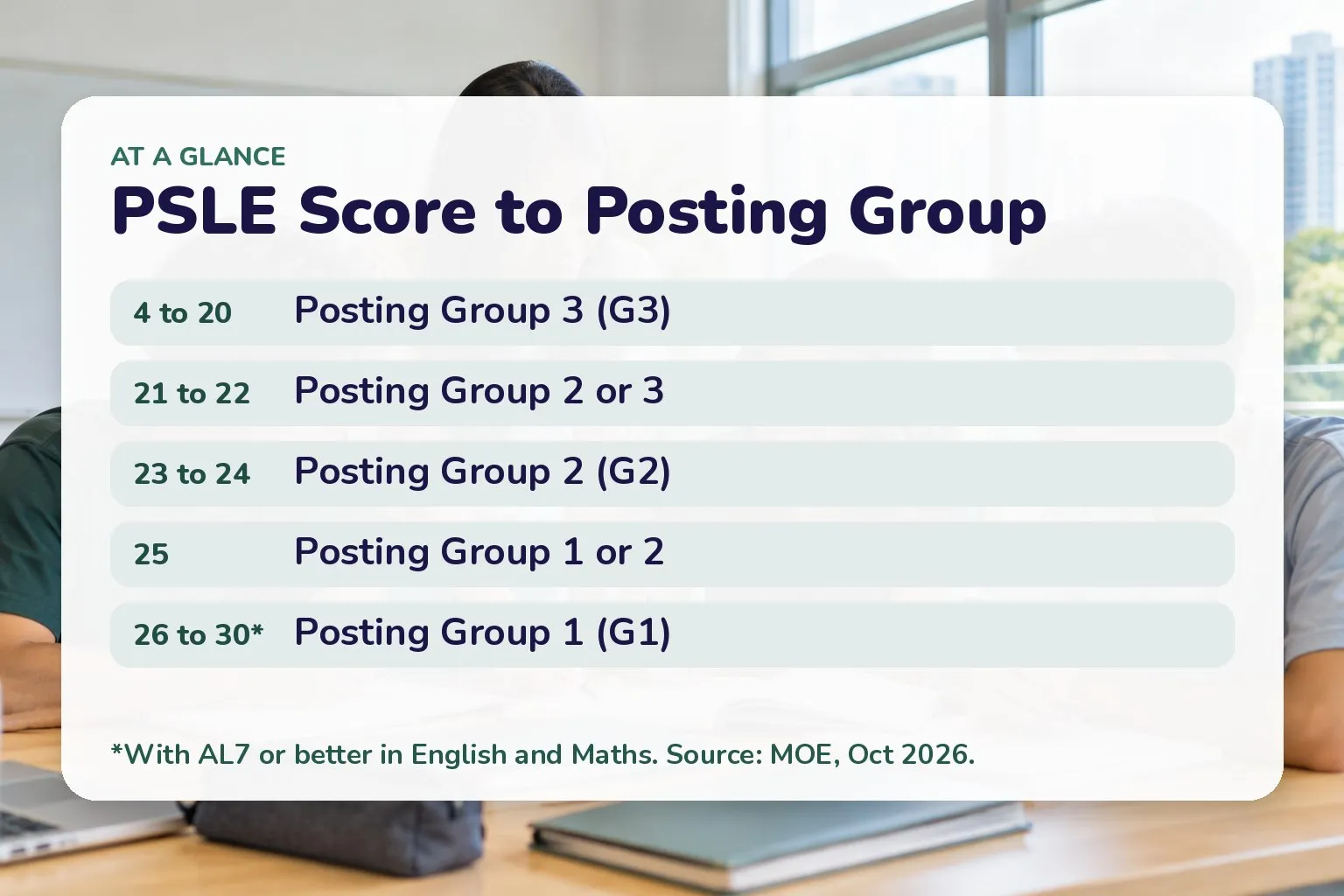
The Posting Group sets the starting subject level. Source: MOE.
| PSLE Score | Posting Group | Indicative starting level |
|---|---|---|
| 4 – 20 | 3 | G3 |
| 21 – 22 | 2 or 3 | G2 or G3 |
| 23 – 24 | 2 | G2 |
| 25 | 1 or 2 | G1 or G2 |
| 26 – 30 (with AL7 or better in English and Maths) | 1 | G1 |
Where a score spans two Posting Groups, the family chooses one during S1 posting, and that choice applies to all six school choices.
A starting point, not a label
The most important idea in Full SBB is that the Posting Group is a starting point. From there, a student can offer individual subjects at a more demanding level as they progress, based on aptitude and performance. A child who does well in a G2 subject may move it to G3; the system is designed to be flexible rather than fixed for four years.
At lower secondary, students are grouped into classes by subject level for the banded subjects, so a student may be with different classmates for different subjects.
Why the change matters for parents
- Your child is not “streamed”. Strength in one subject is not held back by a weaker one.
- The PSLE Score opens a Posting Group, not a stream. Read how the score is built in PSLE AL scoring.
- Cut-off points are per Posting Group. A school can admit across Posting Groups, so its cut-off points differ by group.
- Movement is built in. Subjects can be taken at a higher level later, so the start of Secondary 1 is not the final word.
For how the Posting Group and your school choices combine on results day, see Secondary 1 posting.
General information based on MOE sources, not official guidance. Confirm current rules on moe.gov.sg.
Sources
- Secondary school experience under Full SBB — Ministry of Education Singapore (as of October 2026)
- FAQs — PSLE Scoring System (posting) — Ministry of Education Singapore (as of October 2026)