JC vs Polytechnic vs ITE: How to Choose

JC is a two-year academic route to the A-Levels and university, admitted on your L1R5 aggregate (20 or lower). Polytechnic is a three-year applied diploma admitted on your ELR2B2 net aggregate (26 or lower for most courses). ITE offers hands-on Nitec and Higher Nitec that can lead to a polytechnic diploma. Choose on how your child learns, not prestige.
After the O-Levels, students in Singapore choose between a junior college (JC), a polytechnic, or the Institute of Technical Education (ITE). None is “better” in the abstract — they suit different learners and lead to different next steps. Here is how they actually compare.
At a glance
| JC | Polytechnic | ITE | |
|---|---|---|---|
| Length | 2 years | 3 years | 1–2 years (Nitec / Higher Nitec) |
| Style | Academic, broad | Applied, industry-focused | Hands-on, practical |
| Leads to | A-Levels → university | Diploma → work or university | Nitec/Higher Nitec → polytechnic or work |
| Admitted on | L1R5 aggregate | ELR2B2 net aggregate | ELR2B2 / aptitude-based routes |
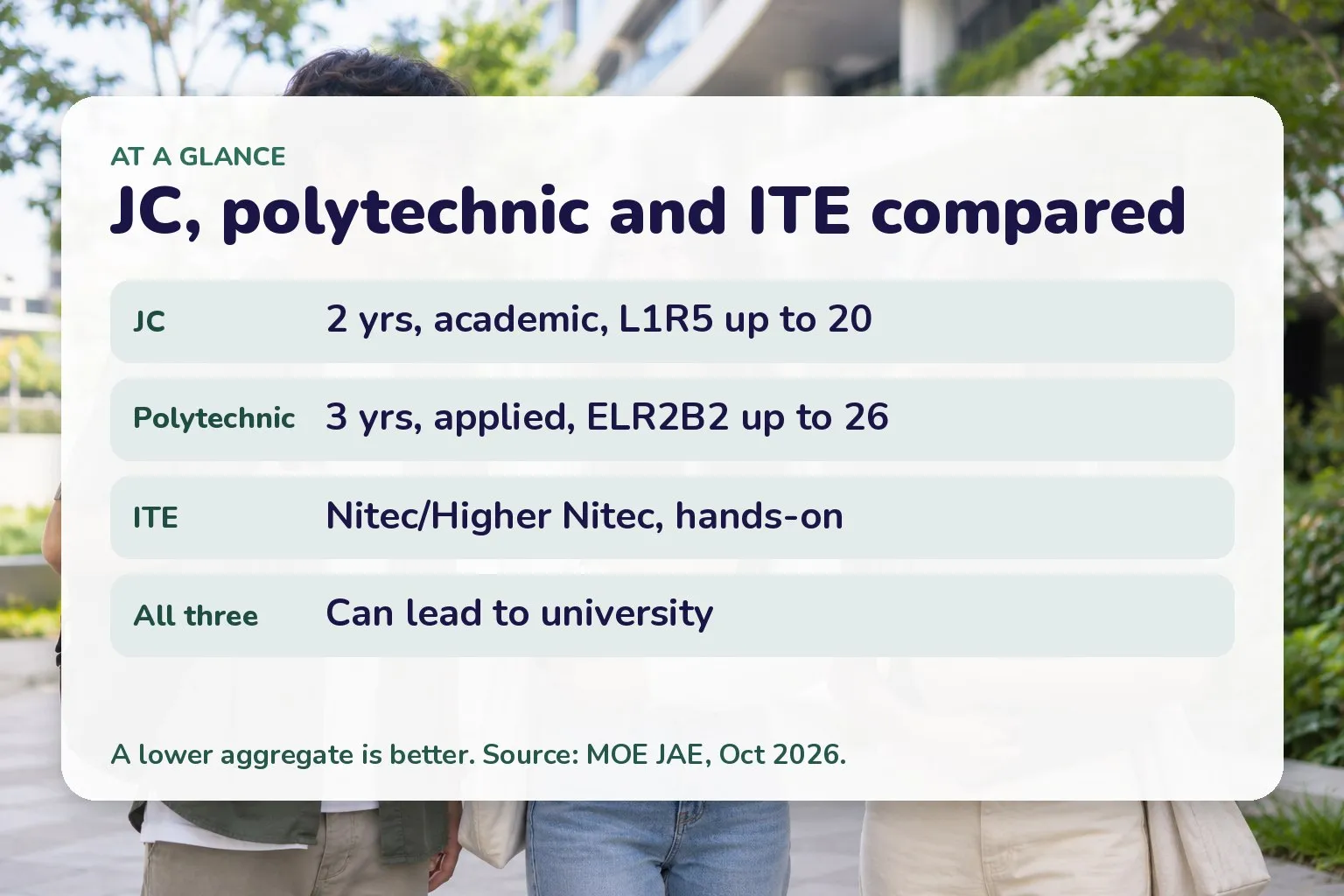
Different routes, not a ranking. Source: MOE.
Junior college (JC)
JC is a two-year academic programme leading to the GCE A-Level examination, and it is the most direct route to university. To be eligible for a JC course through the Joint Admissions Exercise (JAE), your L1R5 gross aggregate must not exceed 20, and you must meet MOE’s grade requirements in English, Mathematics and Mother Tongue. L1R5 is your first language plus five relevant subjects; a lower aggregate is better, and bonus points can be subtracted to give a net score. JC suits students who enjoy academic study across several subjects and are aiming for university.
Polytechnic
A polytechnic offers a three-year diploma with a strong applied and industry focus — you specialise early in a field such as engineering, design, business, health or IT. Admission through JAE uses the ELR2B2 net aggregate, which must not exceed 26 for most courses (the Diploma in Nursing allows up to 28). A diploma can lead straight to work, or to university with advanced standing. Poly suits students who prefer learning by doing and already have a field in mind.
ITE
ITE provides hands-on Nitec and Higher Nitec certificates with a practical, skills-based approach. It is a strong route for students who learn best by doing and want a clear, applied pathway. Many ITE graduates progress to a polytechnic diploma and beyond. Admission is through the aggregate score or aptitude-based routes such as the Early Admissions Exercise.
How to choose
- How does your child learn? Academic breadth points to JC; learning by doing points to poly or ITE.
- How clear is the goal? A specific field favours a poly diploma or ITE course; an open, university-bound plan favours JC.
- All roads can reach university. JC is the most direct, but poly and ITE graduates progress too — the choice is about fit, not a ceiling.
A changing landscape
The admission bases are being updated. Under the new Post-Secondary Admissions framework (from the 2028 exercise), JC admission moves to an L1R4 aggregate of 16 or lower, reflecting the move away from streams under Full Subject-Based Banding. If your child sits the national exams in 2027 or later, confirm which aggregate and cut-offs apply to their cohort on MOE’s site. For how marks became grades earlier in the journey, see PSLE AL scoring; for the six-year alternative to the O-Level route, see the Integrated Programme.
General information based on MOE sources, not official guidance or admissions advice. Confirm the aggregate rules and cut-offs for your cohort on moe.gov.sg.
Sources
- Joint Admissions Exercise (JAE): Admissions matters of JCs and MI — Ministry of Education Singapore (as of October 2026)
- Polytechnic admission and courses (JAE) — Ministry of Education Singapore (as of October 2026)
- Post-Secondary Admissions (PSE): JC and MI — Ministry of Education Singapore (as of October 2026)