Home-School Distance Priority in P1 Registration
When a primary school is oversubscribed from Phase 2B onwards, MOE admits children by citizenship first (SC before PR), then by home-school distance: within 1km, 1km to 2km, then beyond 2km. Balloting happens only inside the category where places run out. A child admitted through a distance category must stay at the registered address for at least 30 months.
Home-School Distance (HSD) is the rule MOE uses to decide who gets priority when a primary school has more applicants than places. It kicks in from Phase 2B onwards and works together with citizenship. Understanding it is the single most useful thing for a Phase 2C family with no prior tie to a school.
The priority order
When a phase is oversubscribed, places are filled strictly in this order:
| Order | Group |
|---|---|
| 1 | Singapore Citizen (SC) living within 1km of the school |
| 2 | SC living between 1km and 2km |
| 3 | SC living beyond 2km |
| 4 | Permanent Resident (PR) living within 1km |
| 5 | PR living between 1km and 2km |
| 6 | PR living beyond 2km |
MOE works down this list. All SCs within 1km are admitted before any SC in the 1–2km band is considered, and every SC category is cleared before any PR is considered. Balloting is used only within the one category where places run out — not across the whole phase.
A worked example
Suppose a school has 70 places left in Phase 2C and receives these SC applications: 60 within 1km, 20 between 1km and 2km, and 5 beyond 2km.
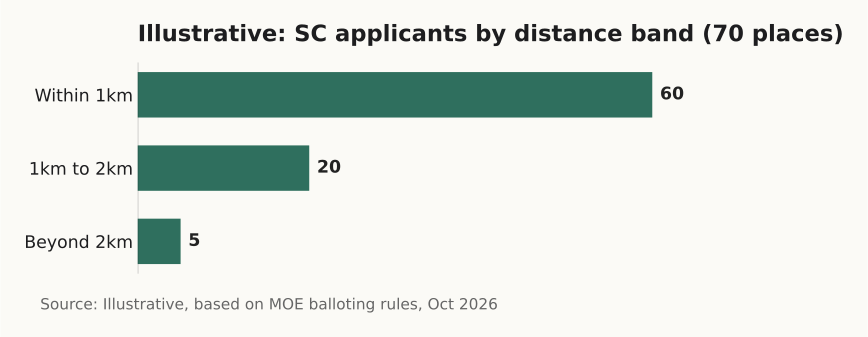
Illustrative figures. The 1km–2km group ballots for the 10 places left after the within-1km group. Source: MOE balloting rules.
- The 60 SCs within 1km are all admitted first.
- That leaves 10 places for the 20 SCs in the 1–2km band, so those 20 ballot for the 10 remaining places.
- The 5 SCs beyond 2km, and all PR applicants, get no place in this phase.
This is why living within 1km is such an advantage — but it is still not a guarantee. If there were 80 SCs within 1km for 70 places, even that nearest group would have to ballot.
How distance is measured
Distance is not a straight line between two dots. MOE measures from any point on the school’s land boundary to your home’s building outline, using the Singapore Land Authority’s OneMap School Query service. The address used is the one on the registering parent’s NRIC. You can check your own home’s distance to a school on OneMap in your registration year.
The 30-month stay requirement
If your child gains priority admission through a distance category, you must continue to live at the registered address for at least 30 months from the start of the registration exercise (for the 2026 exercise, that start date is 30 June 2026). The same 30-month rule applies to a child admitted under the “endorsed active community leader” route to a school within 2km. This is to keep the distance priority fair — it is meant for families genuinely living near the school.
What this means for your plan
- If you have no tie to a school, your realistic options in Phase 2C are schools where you fall in a strong distance band — ideally within 1km.
- Check the actual distance on OneMap before deciding; estates that feel “near” can fall outside 1km.
- Do not move purely to chase a school unless you can meet the 30-month stay requirement.
- Read how the distance rule sits inside the wider process in our guide to P1 registration phases, and use official data when shortlisting in how to choose a primary school.
General information based on MOE sources, not official guidance. Confirm current rules on moe.gov.sg and check distances on OneMap for your registration year.
Sources
- How distance affects priority admission for P1 registration — Ministry of Education Singapore (as of October 2026)
- Understand balloting in P1 registration — Ministry of Education Singapore (as of October 2026)
- Address used for registration — Ministry of Education Singapore (as of October 2026)